The building at 891 Amsterdam Avenue in New York City is a hostel now. Richard Morris Hunt designed its expanded form, and for most of a century it housed the Association for the Relief of Respectable Aged Indigent Females. The charity was founded in 1814 for elderly women with no means, including widows of soldiers from the Revolution and the War of 1812. Its first residence, built in 1838, gave those women somewhere to go other than the almshouse.
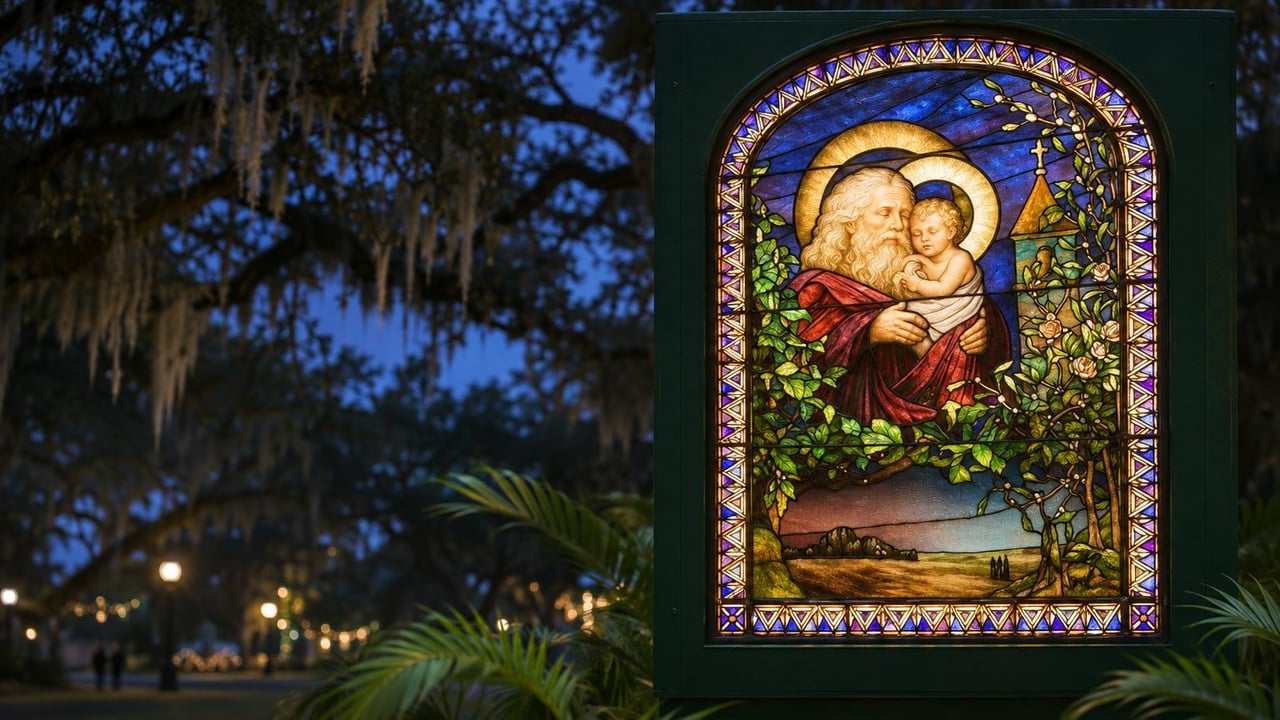
On Thursday, December 3, seven windows from that building's chapel will stand in Winter Park's Central Park for one evening. The Charles Hosmer Morse Museum of American Art and the City of Winter Park are presenting the 48th annual Christmas in the Park. The Tiffany Studios glass comes on at a signal at 6:15 p.m., and the Bach Festival Society performs beneath it. Most people on the lawn will see beautiful holiday glass. Each window also carries a woman's name, and the names explain why the windows exist.
Seven Names From a Board of Managers
All seven windows are memorials with religious themes. Tiffany Studios made them for the Association's chapel. They honor women who served on the charity's volunteer Board of Managers in 1881 to 1883, while the Hunt building was being planned and built. The windows were how the institution remembered the women who oversaw that building project.
The Morse lists the seven, with dates, as:
- Julia Henop memorial window, c. 1890s
- Katharine Hinman Hamlin memorial window, c. 1908
- Ruth Seely Dunning memorial window, c. 1890s
- Sophia Catherine Minton memorial window, c. 1895
- Almy Townsend Hicks memorial window, c. 1890s
- Anna B. Innes memorial window, c. 1895
- Eliza M. Morgan memorial window, c. 1908
The dates span roughly two decades. Some panels came from Tiffany's workshop in the 1890s and others close to 1908, so the row in Central Park shows the studio's work at different points in its run, all made for one room. The dates in the Morse's own collection listing are the ones to use if you plan to look up a particular window before the evening.
How a New York Chapel Ended Up on a Winter Park Lawn
In 1974 the residence on Amsterdam Avenue was threatened with demolition. Hugh and Jeannette McKean bought the chapel windows at the request of the Association's board. The sale happened at the board's own request, in the same year the Association's run ended. The Morse dates the charity 1814 to 1974.
Five years later, in 1979, Jeannette Genius McKean and Hugh F. McKean started Christmas in the Park to share part of their rare Tiffany collection with the public in an informal setting. The windows went from a private chapel for one community of women to a public lawn in Winter Park. The McKeans could have hung them in a gallery. They chose a park, at night, with no ticket. The Morse still runs it that way 47 years later. Admission costs nothing, and tables are the only thing the museum asks guests to leave at home.
Hugh F. McKean's name is also on the Morse's fall exhibition. The museum opened its 2026–27 season on October 13 with Revolt in the Parlor: Escaping Victorian Taste. The exhibition takes its title from a 1969 book of lectures edited by Hugh F. McKean and shows more than 250 objects from 1890 to 1959 across three galleries. The memorial windows date from the same years the exhibition covers.
The Corner Where the Windows Go Up
The Morse sets the windows in the northern section of Central Park, near Garfield and Park avenues, about a block from the museum. This year that corner has something new. The city held its October 13 ceremony for the finished Phase 1 of the Park Avenue Refresh at Garfield and Park, the southern edge of that phase. North of the intersection, Park Avenue now has new dark-sky streetlights with banner arms and hanging baskets, repaired sidewalks and planter boxes, and additional live oaks. The city expects Phase 2, from Garfield to New England avenues, to begin in January 2027. This December the windows go up at the line between the finished stretch and the next one. Our summer piece on where the neighborhood moved during the Refresh covers how the construction started.
The Evening, Hour by Hour
The windows are installed first, and blankets and lawn chairs can go down starting at 4 p.m. That gives early arrivals more than two hours before the lights come on. The schedule looks like this:
| Time | What happens |
|---|---|
| 4:00 p.m. | Blankets and lawn chairs may be set up |
| 6:15 p.m. | Signal is given and the window lights turn on |
| About 8:00 p.m. | Choral concert ends |
| 8:30 p.m. | Windows go dark |
The half hour after the music ends is the quietest time to walk the row and read each name up close. The Bach Festival Society lists the 2026 performers as the Bach Vocal Artists, the Bach Festival Children's & Youth Choir and the Bach Festival Brass Ensemble, with John V. Sinclair conducting, in a program of carols and brass fanfares.
The Morse points guests to street parking, its own museum lot and the City of Winter Park lots, and the city publishes a printable downtown parking map. The event is also a short walk from the Winter Park SunRail station. The city handles park use, security, crowd management, traffic control and road closures for the night. Driving guests should check the city's closures page that afternoon.
Seeing the Rest of the Collection Before and After
The seven windows are one evening's selection from a much larger collection that includes Tiffany works and art and architectural elements from Laurelton Hall. Anyone who leaves the park wanting more can see the rest for free on several dates this season.
The first comes this weekend. The Morse's Thanksgiving Weekend Celebration has free admission on Friday, November 27, from 9:30 a.m. to 8 p.m., with live music from 5 to 8 p.m. It continues Saturday, November 28, from 9:30 a.m. to 4 p.m., and Sunday, November 29, from 1 to 4 p.m. Sunday is also Museum Store Sunday. Downtown's holiday lights also start sparkling on Friday the 27th, along with the Park Avenue District's cathedral of lights in Central Park and the children's carousel.
After that, Holiday Friday Nights have free admission from 4 to 8 p.m. and music from 5 to 8 p.m. on four Fridays. The Beautiful Music Jazz Quartet plays November 27, Beautiful Music Three Flutes Only plays December 4, harpist Victoria Lynn Schultz plays December 11, and the Beautiful Music Paint It Black Trio plays December 18. The December 4 date is the night after Christmas in the Park. Winter on the Avenue runs that same evening from 5 to 9 p.m., with the Annual Tree Lighting Ceremony for the city's Christmas tree in Central Park. Popcorn Flicks starts at 7 p.m. with It's a Wonderful Life, preceded by Mickey's Christmas Carol. Someone who saw the memorial windows on the lawn Thursday can walk through the galleries for free on Friday and still make the tree lighting.
The Morse's last free holiday date is Christmas Eve, Thursday, December 24. Admission is free from 9:30 a.m. to 4 p.m., with live music from 1 to 4 p.m.
Between Thanksgiving and Christmas Eve, Central Park has a parade, a pops concert and a big band. Christmas in the Park is the one evening of the season that traces back to New York in 1974, when the Association's board asked the McKeans to buy its chapel windows. On December 3, Henop, Hamlin, Dunning, Minton, Hicks, Innes and Morgan are lit at the north end of the park from 6:15 to 8:30 p.m.
If a December 3 evening under the Tiffany glass is part of how you picture a season in Winter Park, the advisors at Elite Sport Network would be glad to talk through the Winter Park streets within a walk of Central Park and the Morse. Book a private consultation.